


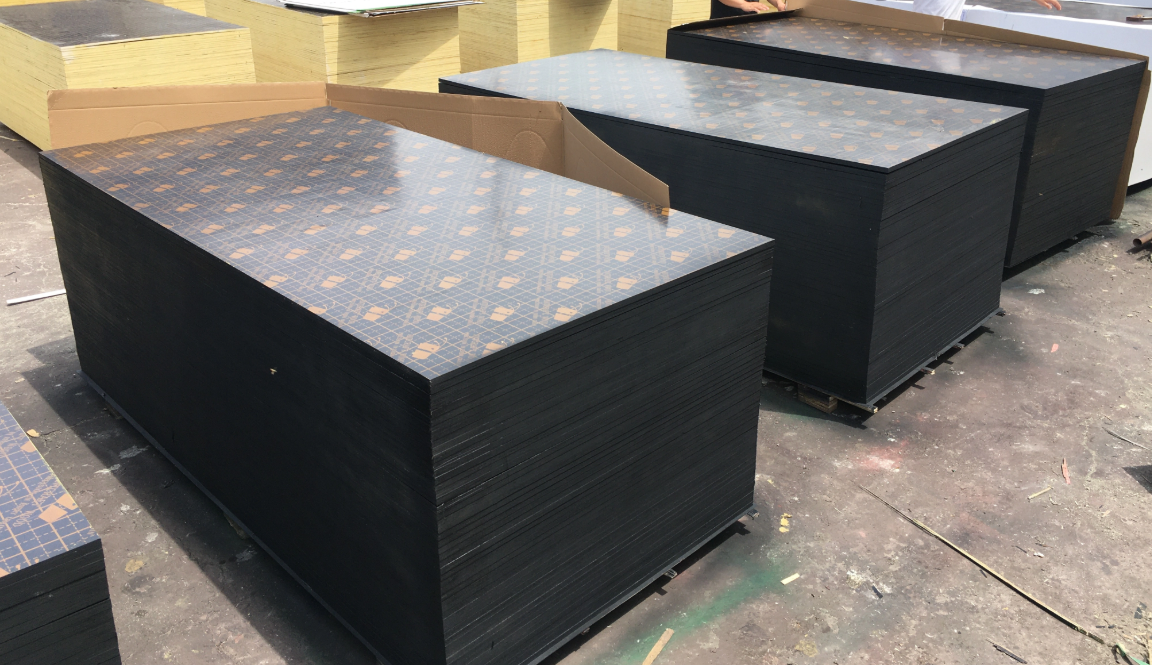
Many buyers ask the wrong question when sourcing concrete formwork plywood: “Is your board waterproof?”
That is not the right question.
The right question is: “How long can this board maintain its structural integrity under high heat, high moisture, and repeated concrete contact?”
A panel can appear “waterproof” on the surface and still fail within five pours. The difference between a panel that delivers 20+ reuses and one that fails after five comes down to one critical factor: the glue that holds it together.
This article explains WBP phenolic technology, why it matters for wholesale film faced plywood procurement, and how to verify a film faced plywood manufacturer‘s claims before you buy.
What is WBP Phenolic Glue?
WBP stands for Weather and Boil Proof. It is the highest durability classification for wood panel adhesives, specifically designed for exterior and high-moisture applications.
Phenolic resin is a thermosetting adhesive that undergoes an irreversible chemical change under heat and pressure during production. Once cured, it creates a bond that is actually stronger than the wood fibers themselves—meaning the wood will fail before the glue line does.
To pass the WBP standard, a panel must survive 72 hours of continuous boiling water immersion without delamination. This is not “moisture resistant.” This is boil proof.
How WBP Compares to Standard Glues
| Glue Type | Water Resistance | Boil Test Pass | Best Application | Relative Cost |
|---|---|---|---|---|
| Urea-Formaldehyde (UF) | None | Fails within minutes | Interior furniture | Low |
| Melamine (MR) | Moderate | 12-hour pass | Interior joinery, cabinetry | Medium |
| WBP Phenolic | Maximum | 72-hour pass | Concrete formwork, marine, outdoor | High |
Source: Industry technical data
When sourcing wholesale film faced plywood, understanding these glue distinctions is the first step toward avoiding premature panel failure.
The chemistry explains the difference: phenolic resin is fully cross-linked during production, leaving virtually no free formaldehyde and forming a permanent bond. Melamine-urea blends, by contrast, trap more free formaldehyde within the polymer network and off-gas slowly at room temperature.
Key distinction: Emission standard (E0/E1/CARB P2) and glue type (MR/WBP) measure different properties. Do not confuse them. A panel can be E0 and still use MR glue—which will fail on a concrete site.
Film Weight: The Second Critical Variable
Glue holds the core together. Film protects the surface. A panel with the best WBP glue but thin film will fail—because the surface wears out, exposing the core to moisture and alkali attack from concrete.
Film Weight Comparison
| Film Weight | Typical Use | Expected Reuses | Application |
|---|---|---|---|
| 120g/m² | Standard commercial | 5–10 times | Low-demand projects |
| 135–170g/m² | Enhanced commercial | 8–12 times | Medium-demand construction |
| ≥220g/m² | Premium phenolic | 15–20 times | High-rise, commercial, infrastructure |
| 220–350g/m² Dynea | Premium export-grade | 25–40+ times | Architectural concrete, demanding projects |
Industry data indicates that 120–130g/m² film at low-cost suppliers typically yields 4–8 reuses even under ideal site conditions. Premium 220g/m² phenolic film from AICA or Dynea achieves 15–20 reuses with proper handling. The heavier film contains more phenolic resin, providing superior abrasion and chemical resistance.
Film weight determines reuse count more than film color does—brown, black, or red makes little difference. Weight is everything.
The Synergy: Glue + Film + Core = Real Performance
Here is where many wholesale film faced plywood buyers get caught:
| What You Buy | What You Get |
|---|---|
| Good glue + thin film | The core lasts, but the surface fails early. You waste the core’s potential. |
| Thick film + poor glue | The surface looks good, but internal delamination starts after 5–8 pours. |
| Good glue + thick film + high-density core | 20+ reuses become achievable. |
This is why specifying only “film faced plywood” is not enough. A professional film faced plywood supplier will provide detailed specs on all three.
How to Verify WBP Claims – Reading the Lab Report
When a film faced plywood manufacturer claims WBP phenolic, ask for the third-party test report (SGS, Intertek, or TÜV) and look for:
- Boiling Water Test (EN 314-2 Class 3 or similar)
Minimum requirement: 72 hours boiling without delamination
Some suppliers attempt to blend phenolic with urea-formaldehyde to reduce cost. Blended resins lose the WBP advantage and may not pass the full 72-hour test
- Bonding Strength
Minimum: ≥0.7 N/mm² per EN 314-2
Premium grades achieve ≥1.0 N/mm²
- Density (Core Material)
≥600 kg/m³ for construction grades
Hardwood cores (eucalyptus, birch, acacia) outperform poplar for high-reuse applications
- Moisture Content
Acceptable range: 8%–12%
Above 14% risks mold and swelling during shipping
The Procurement Checklist – 3 Questions to Ask
When speaking with a wholesale film faced plywood supplier, ask these three questions:
Q1: “What resin supplier do you use for your phenolic glue? Is it pure PF or a blended formulation?”
Genuine phenolic resin (PF) is required for full WBP performance. Some suppliers blend phenolic with urea-formaldehyde to cut costs—but blended resins fail the 72-hour boil test.
Q2: “What is the film weight, and can you specify it in the contract as ≥220g/m²?”
Film weight directly determines reuse count. 120g/m² is for budget. 220g/m² is for performance. Do not accept vague language—write it into the contract.
Q3: “Can you provide the third-party inspection report for the batch we are ordering?”
Accept only independent test reports—not in-house “certificates of conformity.” SGS, Intertek, or TÜV reports provide objective verification.
A Supplier That Delivers on the WBP Promise
Understanding the science behind WBP phenolic plywood is one thing. Finding a film faced plywood manufacturer that consistently executes on that science—batch after batch, container after container—is another.
Fortuna is a film faced plywood supplier that has built its reputation on exactly this: the disciplined application of WBP phenolic technology across three decades of continuous production.
WBP Phenolic – From Specification to Production Reality
Many suppliers claim to produce WBP phenolic plywood, but few can document the full technical chain. Fortuna can.
Pure Phenolic Resin (PF) – Fortuna uses 100% pure phenolic resin for its WBP-grade panels, not blended urea-phenolic formulations that compromise boil-proof performance. The resin is sourced from certified chemical suppliers with full batch traceability.
Premium Film Specification – For wholesale film faced plywood requiring high reuse cycles, Fortuna offers ≥220g/m² phenolic film, with Dynea brand available as a premium upgrade. This is the same film weight and quality standard that enables 20–25+ reuses in demanding commercial and infrastructure projects.
High-Density Hardwood Core – Fortuna’s WBP panels use eucalyptus and mixed hardwood cores with densities reaching 600–700kg/m³, providing the structural stability required to withstand repeated concrete pressure without deformation.
Full Laboratory Testing – Every batch undergoes in-house and third-party verification, including the 72-hour boiling water test, bonding strength measurement (≥1.0 N/mm²), and thickness tolerance checks. Fortuna provides original test reports—not self-printed “certificates of conformity.”
The Scale to Deliver Consistently
Technical specifications mean nothing without production consistency. Fortuna operates a 208,000m² manufacturing facility in Linyi, China—the world’s largest plywood production cluster—with an annual capacity of 300,000m³ and monthly shipments exceeding 100 containers to 170+ countries.
This scale enables:
Stable raw material sourcing – Long-term contracts with veneer and resin suppliers ensure consistent input quality
Dedicated WBP production lines – Separate production streams prevent cross-contamination with non-WBP grades
Batch-to-batch consistency – ISO 9001-certified quality management systems ensure repeatable outcomes
Certifications That Matter for Global Procurement
Fortuna holds the international accreditations that professional buyers require:
FSC – Sustainable, legally sourced timber
CE – EU construction product compliance
CARB Phase 2 – Stringent formaldehyde emission control
ISO 9001 – Certified quality management
EUDR compliance – Full traceability for European market requirements
Real-World Validation on Landmark Projects
The ultimate test of WBP phenolic technology is not the lab—it is the construction site. Fortuna’s film faced plywood 18mm / 1220x2440mm and other concrete formwork plywood specifications have been trusted on:
Beijing National Stadium (Bird’s Nest)
Hamad International Airport (Doha)
Shanghai Pudong International Airport
Burj Khalifa (Dubai)
When the world’s tallest building and critical transport infrastructure rely on a film faced plywood manufacturer‘s products, the technical claims are no longer claims—they are verified performance.
Beyond the Panel – Partnership and Support
What sets Fortuna apart from the typical film faced plywood supplier is not just product quality—it is the commitment to buyer success:
Technical consultation – Helping buyers select the right film weight, core density, and glue specification for their specific project
Quality verification support – Providing inspection protocols and third-party testing coordination
Responsive communication – Dedicated export teams ensuring clear, fast responses to technical and logistical questions
FAQs – Technical Questions Buyers Ask About WBP Phenolic Plywood
Q1: What is the difference between WBP and MR glue?
A: MR (Moisture Resistant) glue passes a 12-hour boiling water test and is suitable for indoor humid environments. WBP (Weather and Boil Proof) passes a 72-hour boiling test and is the only glue type rated for concrete formwork, marine, and exterior applications. MR glue will delaminate within 3–5 concrete pours.
Q2: Does WBP glue have higher formaldehyde emissions?
A: No—in fact, the opposite is true. During phenolic resin production, formaldehyde reacts almost completely with phenol, forming a fully cross-linked polymer. Little free formaldehyde remains. WBP phenolic panels typically meet E1 or CARB P2 naturally without additives. Melamine-urea blends often trap more free formaldehyde.
Q3: What film weight should I specify for 20+ reuses?
A: For projects requiring 12+ reuses, specify minimum 135g/m² phenolic film. For 15–20+ reuses, specify ≥220g/m² premium film (AICA or Dynea). Film weight is the single largest factory-side variable determining reuse count.
Q4: How many reuses can I expect from 18mm film faced plywood?
A: Budget grade with 120g/m² film: 4–8 reuses. Standard grade with 135–170g/m²: 8–12 reuses. Premium grade with 220g/m² film and WBP phenolic glue: 15–20 reuses under controlled site conditions. Using Dynea film at 220–350g/m² can achieve 25–40+ reuses.
Q5: What causes WBP panels to fail before the claimed reuse count?
A: The number one cause is unsealed cut edges. When panels are cut on site, exposed core veneers absorb moisture and alkali from concrete, causing edge delamination within 2–3 pours. Proper edge sealing immediately after cutting is essential. Other causes: lack of release agent, rough stripping methods, and poor storage.
Q6: How can I verify a supplier’s WBP claim?
A: Request third-party test reports (SGS/Intertek) showing:
72-hour boiling water test result (no delamination)
Bonding strength ≥0.7 N/mm²
Film weight confirmed in g/m²
Adhesive specification: pure PF resin (not blended phenolic-UF)
Also ask for the supplier’s adhesive resin supplier—genuine PF resin manufacturers are traceable and documented.
Q7: Can I use WBP plywood for non-formwork applications?
A: Yes. WBP phenolic panels are also used for marine construction, truck flooring, scaffolding decks, and industrial platforms where moisture, chemicals, or mechanical stress are concerns. However, specifying WBP for indoor furniture adds $15–25 per cubic meter without performance benefit—match the spec to the application.
Q8: What is “telegraphing” and should I reject it?
A: Telegraphing is the imprint of the underlying core structure showing through the film surface. While it may affect appearance, it does not typically compromise structural performance. Check your contract—some specifications accept it, others reject it for visible concrete applications.
Conclusion
The difference between a wholesale film faced plywood panel that delivers 20 pours and one that fails after 5 is not marketing—it is chemistry. WBP phenolic glue provides the waterproof, boil-proof bond required for concrete formwork. Film weight determines how long the surface protects the core. Core density determines structural stability under load.
Smart procurement specifies all three. Do not accept vague promises. Require certifications, third-party test data, and contract language that holds the film faced plywood supplier accountable.
Fortuna delivers on all three. With over 30 years of manufacturing experience, full international certifications, and a portfolio of landmark projects, Fortuna produces concrete formwork plywood and WBP phenolic plywood that contractors trust for the world’s most demanding structures.
Ready to upgrade your formwork specification? Contact Fortuna today for technical data sheets, third-party test reports, and a customized procurement proposal for your next project.


