


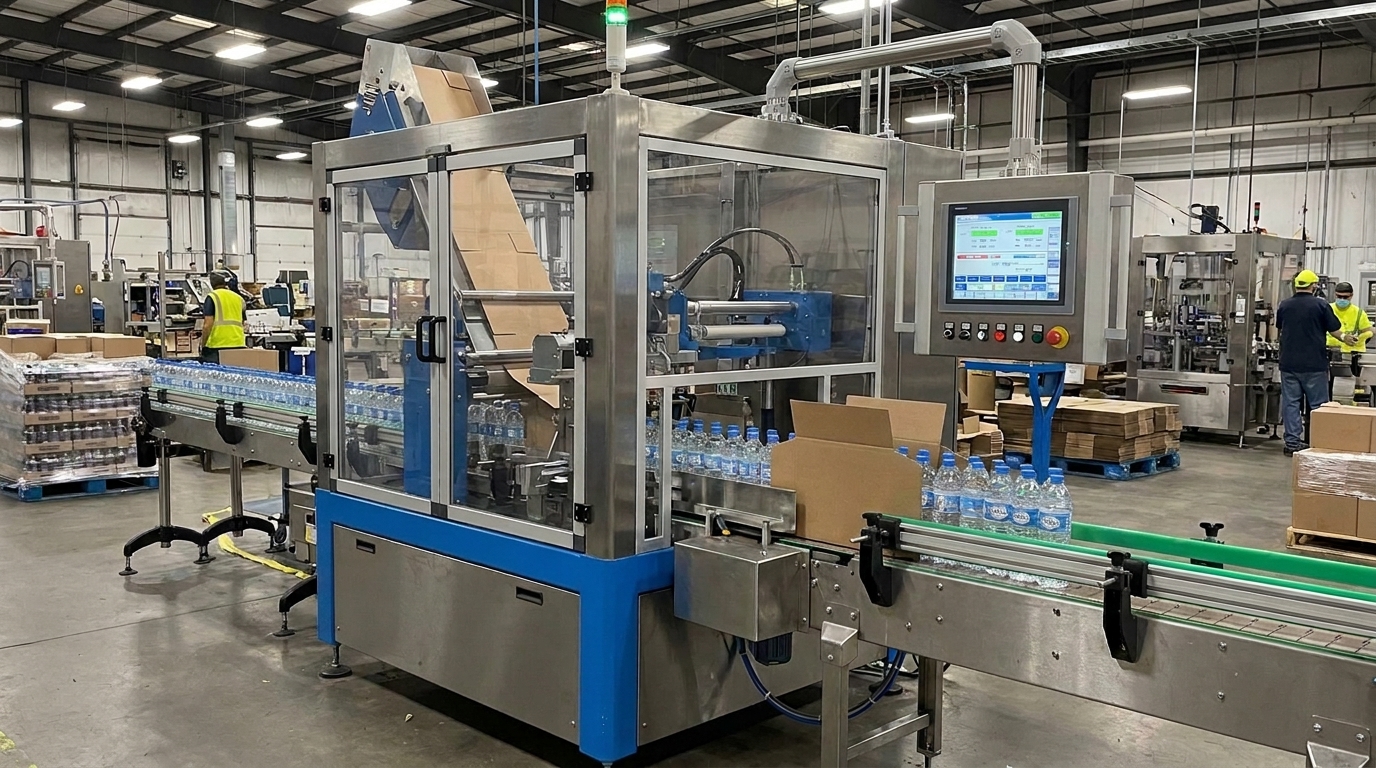
Throughput determines how many finished cases a packaging line needs to produce within a specific period. Calculating this figure correctly helps manufacturers select equipment that meets production demand without paying for unnecessary capacity.
A wrap around case packer should match the actual output requirements of the production line rather than relying only on a machine’s advertised maximum speed. A useful calculation considers product demand, units per case, available operating time, planned downtime, and an appropriate capacity margin.
What Does Packaging Throughput Mean?
Packaging throughput refers to the number of finished cases a machine or line produces during a given period.
Manufacturers commonly express throughput as cases per minute, cases per hour, or cases per shift. The correct measurement depends on how the production facility tracks output.
For example, a plant that needs to pack 12,000 products during an eight-hour shift cannot select a machine based solely on the number of products entering the line. The products must first translate into finished cases.
Start With Production Demand
The first step involves determining how many products the packaging line needs to handle.
Suppose a production facility manufactures 48,000 units during an eight-hour shift and places 24 units into each shipping case. The required case output would be:
48,000 ÷ 24 = 2,000 cases per shift
The next step involves converting this figure into an hourly or minute-based requirement.
Convert Case Demand Into Hourly Throughput
An eight-hour shift contains 480 scheduled minutes.
Using the example above:
2,000 cases ÷ 8 hours = 250 cases per hour
Or:
250 ÷ 60 = 4.17 cases per minute
This gives a theoretical requirement of approximately 4.2 cases per minute before accounting for downtime or other production losses.
Account for Available Production Time
Scheduled shift time does not always equal actual machine operating time. Changeovers, cleaning, maintenance, material replenishment, product interruptions, and minor stops can reduce available production time.
For this reason, manufacturers should calculate throughput using realistic operating time rather than assuming the machine runs continuously throughout the entire shift.
For example, an eight-hour shift with 45 minutes allocated to planned activities provides:
480 − 45 = 435 available minutes
If the facility still needs to produce 2,000 cases:
2,000 ÷ 435 = 4.6 cases per minute
The required machine throughput has now increased from 4.2 to approximately 4.6 cases per minute.
Consider Overall Equipment Efficiency
Actual production performance depends on more than scheduled operating time. Equipment availability, operating speed, and quality output can all influence effective throughput.
A machine may have a rated speed of 10 cases per minute, but the packaging line may achieve a lower sustained rate because of stops, speed reductions, changeovers, or rejected packages.
Manufacturers should therefore distinguish between:
- Rated machine speed
- Target operating speed
- Average sustained throughput
- Required production throughput
The sustained operating rate provides a more useful figure for equipment selection.
Add a Practical Capacity Margin
Selecting a machine that exactly matches today’s calculated requirement may leave little room for production fluctuations.
Manufacturers often consider additional capacity to accommodate demand increases, minor interruptions, product variation, or future production plans.
For example, a calculated requirement of 5 cases per minute might lead a packaging team to evaluate equipment capable of maintaining a somewhat higher sustained rate under actual operating conditions.
The exact margin depends on the production environment and business requirements.
Use Cases Per Minute for Equipment Comparison
Cases per minute provides a simple way to compare packaging equipment against production requirements.
Consider a facility with these requirements:
| Production Factor | Example |
| Products per shift | 60,000 |
| Products per case | 20 |
| Cases per shift | 3,000 |
| Shift length | 8 hours |
| Planned downtime | 30 minutes |
| Available time | 450 minutes |
| Required throughput | 6.67 cases/minute |
The machine should therefore support a sustained output above 6.67 cases per minute under the actual case format and product conditions.
Calculate Throughput for Multiple Products
Some manufacturers run several products through the same packaging line. Each product may have a different case count, product size, or packaging configuration.
In this situation, calculate the required throughput for each major production scenario.
A product packed in 12-unit cases will generate more finished cases than the same production volume packed in 24-unit cases. The case count therefore affects the workload placed on the packing machine.
A capacity review should account for the product mix rather than using one average figure that hides important differences.
Factor In Changeover Time
Production lines that switch between products or case sizes may require regular changeovers.
Longer changeovers reduce the time available for actual packing. Frequent format changes may also affect the practical throughput of the line.
When calculating equipment requirements, include expected changeover frequency and duration in the available production time.
A machine that handles format changes efficiently may help maintain better overall line utilization.
Consider Upstream Production Capacity
The case packer does not determine the entire line’s output by itself. The upstream production equipment must supply enough products to maintain the required packing rate.
For example, a case packer capable of handling 10 cases per minute cannot maintain that output when the upstream system supplies products equivalent to only 7 cases per minute.
Throughput calculations should therefore compare the capacity of the complete production system.
Check Downstream Capacity
The same principle applies after case packing. Finished cases need to move through inspection, labeling, palletizing, wrapping, or other downstream stages.
A downstream bottleneck may force the case packer to slow down or stop.
Manufacturers should compare the expected throughput of connected equipment to identify the slowest stage in the overall packaging process.
Calculate Product-to-Case Conversion
Production data often comes in units per hour, while case packers operate in cases per minute. Converting between these measurements provides a useful basis for equipment selection.
Use this basic formula:
Required cases per minute = Products per hour ÷ Units per case ÷ 60
For example, a line producing 18,000 units per hour with 30 units per case requires:
18,000 ÷ 30 ÷ 60 = 10 cases per minute
This calculation provides the basic packaging demand before accounting for downtime and capacity margin.
Do Not Confuse Rated Speed With Real Output
Machine specifications may list a maximum speed under defined operating conditions. Actual output can differ based on product characteristics, case dimensions, board quality, changeovers, and line integration.
A useful equipment evaluation should ask how the machine performs with the specific products and cases used in production.
Trial runs and application testing can provide a more realistic view of expected throughput.
Match Throughput With Case Configuration
Case dimensions and product arrangements can influence packing performance. A simple case format may move through the machine differently from a more complex configuration.
Product orientation, number of units per case, case size, corrugated board characteristics, and closure requirements can all affect operating speed.
Manufacturers should provide these details when discussing throughput requirements with equipment suppliers.
How Techflow Pack Can Support Equipment Planning
Techflow Pack focuses on packaging machinery and case packing applications where production requirements need to align with machine capabilities.
When evaluating equipment, manufacturers should provide production volume, product specifications, case configuration, operating schedule, and expected growth. These details help create a more realistic throughput target.
Techflow Pack can also help manufacturers consider how the case packer fits with upstream product handling and downstream packaging equipment.
A Simple Throughput Calculation Process
Manufacturers can use the following process when establishing a target:
- Determine the number of products required per shift or hour.
- Identify the number of products packed in each case.
- Convert product demand into finished cases.
- Calculate available operating time.
- Account for planned downtime and changeovers.
- Determine the required cases per minute.
- Add a practical capacity margin.
- Compare the result with upstream and downstream equipment.
This approach produces a more realistic equipment target than simply choosing the highest available machine speed.
Final Thoughts
Calculating the required throughput for a case packing system starts with production demand and ends with a realistic view of the entire packaging line. Product volume, units per case, operating time, downtime, changeovers, and equipment efficiency all influence the final requirement.
A reliable throughput calculation helps manufacturers choose equipment that supports current production while leaving reasonable room for operational variation. By evaluating actual operating conditions rather than relying solely on rated speed, packaging teams can make better decisions about case packing capacity and line integration.


