


Introduction
Bearings are essential components in modern machinery because they support rotating shafts, reduce friction, and help maintain smooth mechanical operation. Different industrial applications require different lubrication methods depending on operating conditions, equipment design, and maintenance requirements. Two commonly used technologies are water-lubricated bearings and oil-lubricated bearings.
Although both systems perform the same basic function, they differ significantly in their lubrication methods, environmental impact, maintenance requirements, and applications. A water lubricated bearing uses water to reduce friction between moving surfaces, while an oil-lubricated bearing depends on specialized lubricating oil to maintain a protective film. Understanding these differences can help engineers and equipment manufacturers choose the most appropriate solution for their machinery.
What Are Water Lubricated Bearings?
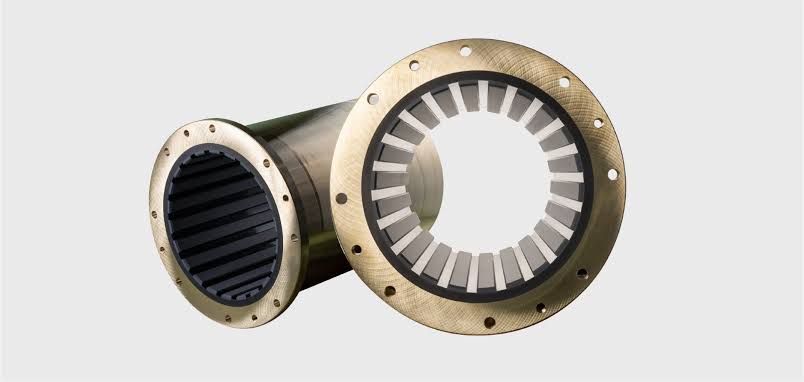
Water-lubricated bearings are designed to support rotating shafts using water as the primary lubrication medium. Water enters the clearance between the shaft and bearing surface, helping establish a lubricating film under suitable operating conditions.
These bearings are commonly manufactured using specialized rubber, polymers, and composite materials that can withstand continuous exposure to water. They are particularly suitable for marine propulsion systems, industrial pumps, hydropower equipment, and water treatment machinery.
One of their main advantages is that they eliminate the need for conventional oil or grease lubrication in systems specifically designed for water-based operation. This can reduce lubricant-related pollution risks and simplify certain maintenance procedures.
What Are Oil Lubricated Bearings?
Oil-lubricated bearings use specially formulated oils to minimize friction and wear between moving components. The lubricant creates a protective film that separates the bearing surfaces and supports smooth mechanical movement.
These bearings are widely used in manufacturing machinery, automotive equipment, turbines, compressors, and heavy industrial systems. Depending on the application, lubrication may be supplied through oil baths, circulation systems, pumps, or other arrangements.
Oil also helps remove heat, protect metallic surfaces, and reduce the effects of friction. However, these systems require proper lubrication management, including monitoring oil condition, maintaining appropriate levels, and replacing contaminated or degraded lubricant.
Key Differences Between Water and Oil Lubricated Bearings
1. Lubrication Method
The most obvious difference is the lubrication medium. Water-lubricated bearings use water to create a lubricating film between moving surfaces, whereas oil-lubricated bearings depend on specialized oils.
Water-based systems are generally preferred in equipment where water is readily available and compatible with the bearing materials. Oil-based systems are suitable for machinery requiring controlled lubrication under specific mechanical and thermal conditions.
2. Environmental Impact
Environmental performance is another important difference. Oil-lubricated bearings can create pollution risks if lubricant leaks into surrounding soil or water.
A water lubricated bearing reduces dependence on petroleum-based lubricants and can therefore be advantageous in environmentally sensitive applications, particularly marine environments.
However, water lubrication is not automatically impact-free. Water consumption, discharge quality, and material selection must also be considered.
3. Maintenance Requirements
Oil-lubricated systems require regular oil inspections, replenishment, and replacement. Additional components, such as filters, pumps, and seals, may also require maintenance.
Water-lubricated bearings eliminate conventional oil and grease replacement when designed for continuous water lubrication. Nevertheless, operators must monitor water flow, contamination, clearances, and bearing wear.
4. Cooling Performance
Both lubrication methods help control operating temperatures. Oil absorbs and transports heat away from bearing surfaces, while flowing water can provide effective cooling because of its heat-absorbing properties.
The cooling performance of either system depends on circulation rates, bearing design, operating temperature, and equipment requirements.
5. Material Compatibility
Water-lubricated bearings often use rubber, engineering polymers, and specialized composites that resist moisture and perform effectively in wet environments.
Oil-lubricated bearings commonly use metallic materials and other engineered surfaces designed to work with specific lubricants.
Choosing incompatible materials can result in deterioration, swelling, corrosion, or premature component failure.
Advantages of Water Lubricated Bearings
Water-lubricated bearings offer several benefits in applications where water-based lubrication is practical.
- Reduced pollution risks: They minimize the possibility of oil leakage into surrounding water.
- Simplified lubrication systems: Conventional grease and oil supply arrangements are unnecessary.
- Effective cooling: Circulating water helps remove heat generated during operation.
- Reduced lubrication expenses: Businesses can avoid certain recurring oil and grease costs.
- Marine suitability: They are particularly useful in ship propulsion and underwater machinery.
- Environmental advantages: They support more sustainable equipment designs in appropriate applications.
These benefits make them attractive for marine, pumping, and water-related industrial equipment.
Advantages of Oil Lubricated Bearings
Oil-lubricated bearings also provide important performance advantages.
They are suitable for a wide range of industrial applications and can operate under demanding loads and temperatures when properly designed. Specialized lubricants offer corrosion protection, friction control, and effective heat management.
Oil circulation systems can also provide continuous lubrication in complex machinery. This makes them useful in turbines, compressors, automotive systems, and heavy manufacturing equipment where water-based lubrication may not be practical.
How to Choose the Right Bearing Type
Selecting between water and oil lubrication requires evaluating the machinery’s operating environment and performance requirements.
Consider the following factors:
- Operating load and rotational speed.
- Temperature and pressure conditions.
- Availability and quality of water or lubricating oil.
- Environmental regulations and contamination risks.
- Maintenance resources and operating expenses.
- Material compatibility and expected service life.
Businesses evaluating industrial bearing technologies can also explore the technical resources available from Techemer to understand different engineering solutions and application requirements.
Conclusion
Water-lubricated and oil-lubricated bearings both play important roles in modern machinery, but their suitability depends on the application. Water-based systems offer environmental and maintenance advantages in marine and wet industrial environments, while oil-based systems provide versatile lubrication for many demanding mechanical applications.
By comparing lubrication methods, cooling performance, material compatibility, maintenance requirements, and operating costs, engineers can select the bearing technology that best supports equipment reliability and long-term efficiency.


