


Indoor vs. Outdoor Inflatable Games: Which Option Is Best for Your Event?
Planning an event involves making several important decisions, from choosing the venue to arranging entertainment that keeps guests engaged. Inflatable attractions have become a popular choice for birthday parties, school celebrations, corporate gatherings, community festivals, and family events. However, one important question often arises: should you choose indoor or outdoor inflatable games?
Both options offer unique advantages, and the right choice depends on your event’s size, audience, location, budget, and entertainment requirements. Indoor setups can provide greater protection from changing weather conditions, while outdoor attractions often allow more room for larger structures and energetic activities.
Understanding the differences between indoor and outdoor Inflatable Games can help you select suitable entertainment, manage your event space effectively, and create an enjoyable experience for your guests. This guide compares both options and explains how to choose the best solution for your next event.
What Are Indoor and Outdoor Inflatable Games?
Inflatable games are temporary entertainment structures or interactive attractions made from suitable flexible materials and designed for activities such as bouncing, sliding, obstacle challenges, and sports competitions.
Although some products can be used in either indoor or outdoor settings, not every inflatable is suitable for both environments. Installation requirements, ceiling height, anchoring methods, weather exposure, and available space can affect where a product can be operated safely.
Indoor Inflatable Games
Indoor inflatable games are installed inside suitable venues, such as sports halls, event centers, exhibition spaces, community halls, and large indoor party venues.
Popular options may include compact bounce houses, inflatable basketball games, target challenges, and appropriately sized obstacle courses. Indoor setups can be particularly useful for events where weather protection and predictable scheduling are priorities.
Before selecting an indoor attraction, organizers must verify the venue’s ceiling height, floor capacity, access routes, electrical arrangements, ventilation, and the equipment’s installation requirements.
Outdoor Inflatable Games
Outdoor inflatable games are installed in suitable open-air spaces, including gardens, parks, school grounds, sports fields, and designated festival areas.
Outdoor venues may accommodate larger obstacle courses, inflatable slides, sports challenges, and other attractions that require more room. They can also provide flexibility when an event includes multiple activity zones.
However, outdoor setups require careful attention to ground conditions, anchoring, wind exposure, rain, drainage, and other environmental factors. The equipment must be suitable for the intended outdoor conditions and operated according to the manufacturer’s instructions.
Indoor vs. Outdoor Inflatable Games: Key Differences
The following comparison highlights the main factors to consider when choosing between the two environments.
| Factor | Indoor Inflatable Games | Outdoor Inflatable Games |
|---|---|---|
| Weather exposure | Generally protected from outdoor weather | Exposed to wind, rain, and changing temperatures |
| Available space | Often limited by walls and ceiling height | May provide more room for large attractions |
| Popular activities | Compact bounce houses and interactive challenges | Obstacle courses, slides, and sports attractions |
| Surface requirements | Suitable floors and venue-specific installation arrangements | Suitable ground, anchoring, and drainage |
| Event planning | Can simplify weather-related scheduling concerns | Requires a weather contingency plan |
| Setup considerations | Ceiling clearance, access routes, ventilation, and floor suitability | Ground conditions, anchoring, weather, and access |
| Typical venues | Halls, gyms, exhibition centers, and indoor party venues | Parks, gardens, school grounds, and festival sites |
These differences are general guidelines rather than universal rules. The manufacturer’s specifications and the conditions of the particular venue should determine whether an inflatable can be used safely.
Advantages of Indoor Inflatable Games
Indoor inflatable attractions can be an excellent choice for events where weather protection, controlled surroundings, and convenient access are important.
1. Greater Protection From Weather
One of the main benefits of indoor installations is protection from outdoor rain and wind. A suitable enclosed venue can make it easier to maintain a planned schedule without depending on favorable outdoor conditions.
This can be particularly helpful for birthday parties, school events, winter celebrations, and corporate activities arranged well in advance.
However, indoor venues still require suitable ventilation, temperature management, and compliance with the equipment’s operating instructions.
2. Suitable for Smaller Events
Many indoor events take place in halls or rooms with limited space. Compact inflatable attractions can provide engaging entertainment without requiring a large outdoor area.
For example, a small bounce house or inflatable target game may be appropriate for a children’s party in a suitable venue, provided the equipment’s dimensions and operating requirements are met.
Organizers should measure the installation area carefully and leave enough room for safe entry, exit, supervision, and movement around the attraction.
3. Convenient for Year-Round Celebrations
Indoor venues can be useful when outdoor temperatures or seasonal weather make open-air events less practical.
Sports halls, community centers, and event facilities may provide suitable conditions for inflatable entertainment throughout the year. This flexibility can be valuable for schools, event companies, and organizations with fixed event dates.
4. Easier Integration With Other Activities
Indoor inflatable games can be combined with seating areas, refreshments, music, party decorations, and other entertainment when the venue is appropriately sized.
A well-planned layout can help guests move between activities while keeping entrances, exits, and designated walkways clear.
Organizers should also check whether the venue permits inflatable equipment and whether additional installation or electrical arrangements are required.
Disadvantages of Indoor Inflatable Games
Despite their advantages, indoor installations may present several challenges.
1. Limited Ceiling Height
Some inflatable structures require considerable vertical clearance. Low ceilings, lighting fixtures, beams, sprinklers, and other overhead features may make certain attractions unsuitable.
Always confirm the fully inflated dimensions and required overhead clearance before booking a venue or purchasing equipment.
2. Restricted Installation Space
Walls, pillars, furniture, and fixed installations can limit the available floor area. Large obstacle courses or slides may not fit even when the venue appears spacious.
Measure the usable area rather than relying on the room’s total dimensions. Include the required safety perimeter and space for anchoring or other installation equipment.
3. Venue and Floor Limitations
Not every indoor floor can support every inflatable installation. The venue must be suitable for the equipment’s weight, installation method, and operational forces.
Organizers should confirm the floor requirements, electrical access, ventilation, and any restrictions imposed by the venue before finalizing their plans.
Advantages of Outdoor Inflatable Games
Outdoor installations are often attractive for larger events because they can offer greater layout flexibility and room for a variety of entertainment options.
1. More Space for Large Attractions
Open spaces can accommodate attractions that require substantial room, such as long obstacle courses, large inflatable slides, and multiple sports stations.
This flexibility makes outdoor setups popular for school carnivals, community festivals, sports days, family fun days, and large birthday parties.
Nevertheless, a large open area does not automatically guarantee suitability. The ground, anchoring arrangements, access routes, and required safety clearances must all meet the manufacturer’s requirements.
2. Greater Flexibility for Event Layouts
Outdoor venues may allow organizers to establish separate zones for different activities.
For example, a festival could include a children’s play area, a sports challenge section, a spectator zone, and a refreshment area. Separating these activities can improve guest movement and help prevent congestion.
The layout should keep queues away from entrances, exits, vehicle routes, and other restricted areas.
3. Suitable for Energetic Group Activities
Outdoor spaces can work well for games involving running, racing, climbing, and team participation.
Inflatable obstacle courses, soccer challenges, and basketball shootouts can become central attractions at large gatherings. These games can encourage guests to interact and participate in friendly competitions.
Organizers should select equipment suitable for the intended participants and ensure that its capacity and operating requirements match the expected attendance.
4. Attractive for Seasonal Events
Outdoor inflatable games can complement summer celebrations, school sports days, neighborhood festivals, and community gatherings.
Natural surroundings and open spaces can also make it easier to combine inflatable attractions with other outdoor entertainment.
However, organizers must account for local weather conditions and prepare an alternative plan when conditions become unsuitable.
Disadvantages of Outdoor Inflatable Games
Outdoor attractions provide flexibility, but they also require more environmental planning.
1. Dependence on Weather Conditions
Wind, rain, lightning, and other adverse weather conditions can affect outdoor inflatable operations. Depending on the product and the conditions, organizers may need to stop activities, deflate the structure, or postpone the event.
Always follow the manufacturer’s weather limits and operating procedures. Do not assume that a larger or heavier inflatable can safely operate in stronger winds.
2. Ground and Anchoring Requirements
Outdoor inflatables need an appropriate installation surface and a suitable anchoring system. Grass, soil, and paved areas may have different limitations depending on the product and the available anchoring arrangements.
Inspect the ground for sharp objects, uneven sections, drainage problems, and other hazards before installation. Follow the specified anchoring instructions rather than improvising a securing method.
3. Additional Environmental Considerations
Outdoor setups may require shade, drinking water, suitable drainage, and protection for electrical connections. Dust, mud, and moisture can also increase cleaning and maintenance needs.
For water-based attractions, organizers must consider the water supply, drainage, slip hazards, and any special operating restrictions.
Planning these details in advance can help avoid unnecessary disruption during the event.
Which Inflatable Games Are Best for Indoor Events?
The best indoor attractions are those that fit the venue’s dimensions and operating requirements while providing suitable entertainment for the intended audience.
Compact Bounce Houses
Smaller bounce houses can be suitable for children’s parties in venues with adequate ceiling height and floor space. Choose a model designed for the participants’ age group and ensure the installation complies with the manufacturer’s instructions.
Inflatable Basketball Games
Basketball challenges can provide a straightforward competitive activity without requiring the space needed for a full sports court.
These games may be appropriate for school celebrations, indoor festivals, and private events when the model fits the venue.
Inflatable Target Games
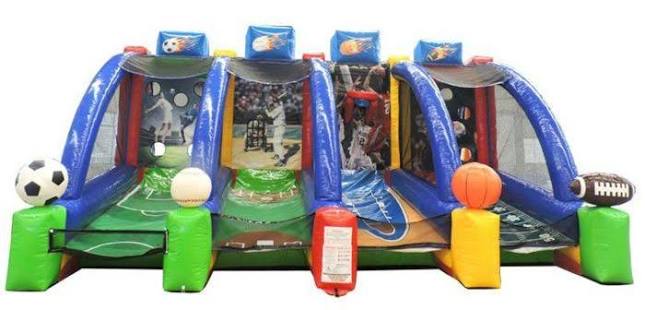
Target-based games can be useful where organizers want interactive entertainment in a relatively compact area. Depending on the design, participants may throw or kick compatible equipment toward a target to score points.
Ensure the playing area is clear and that guests have enough room to participate without interfering with other activities.
Compact Obstacle Courses
Some obstacle courses are designed for indoor use, but their dimensions and height requirements must be checked carefully. Only select a model that is explicitly suitable for the venue and can be installed with the necessary clearance.
Which Inflatable Games Are Best for Outdoor Events?
Outdoor venues can accommodate a broader range of larger attractions, provided the site and weather conditions are suitable.
Large Inflatable Obstacle Courses
Obstacle courses can be a strong choice for school sports days, company gatherings, festivals, and large birthday parties. Participants navigate tunnels, barriers, climbing sections, or other challenges depending on the design.
Select a course that matches the audience’s age and physical abilities, and make sure the venue can accommodate its complete installation area.
Inflatable Water Slides
Water slides can be attractive for summer events and outdoor celebrations. They require suitable water access, drainage, ground conditions, and supervision.
Only use equipment designed for the intended water activity, and follow the manufacturer’s requirements for weather, installation, and operation.
Inflatable Sports Games
Soccer challenges, basketball shootouts, and other interactive sports attractions can encourage friendly competition at outdoor gatherings.
Consider combining several small sports stations so guests can move between activities instead of waiting for a single attraction.
Inflatable Team Games
Human foosball and other group-oriented inflatables can provide shared entertainment for corporate events, school festivals, and community celebrations.
Check the number of participants permitted, the required playing area, and the manufacturer’s rules for age groups and participant combinations.
How to Choose Between Indoor and Outdoor Inflatable Games
Making the right decision requires evaluating your event’s practical needs rather than selecting a venue based on appearance alone.
1. Identify Your Event Type
Start by defining the purpose of the event.
A small birthday celebration may benefit from a compact indoor attraction, while a large school festival may have enough space for several outdoor games.
Corporate events may require activities that encourage teamwork, whereas family gatherings may benefit from a mixture of simple recreational games and age-appropriate physical challenges.
2. Consider Your Audience
Think about the ages, physical abilities, and interests of your guests. Younger children may prefer simple bounce houses and smaller play equipment, while older participants may enjoy sports challenges and obstacle courses.
For mixed-age gatherings, consider separate activity areas or scheduled sessions where appropriate. Always follow the equipment’s participant restrictions.
3. Evaluate the Venue
Measure the available floor area, ceiling height, entrances, and access routes. For outdoor venues, assess the ground surface, anchoring options, drainage, and exposure to weather.
Confirm that the venue allows inflatable installations and that the proposed setup meets the manufacturer’s requirements.
4. Compare Costs
Your budget should include more than the cost of renting or buying the inflatable. Consider delivery, installation, supervision, electricity, cleaning, maintenance, and any applicable permits or insurance.
Indoor venues may involve rental charges and facility requirements, while outdoor events may require additional site preparation or weather contingency arrangements. Actual costs depend on the location, equipment, and service provider.
5. Prepare a Backup Plan
Outdoor events should have a clear procedure for responding to unsuitable weather. This may involve postponement, cancellation, relocation, or moving activities indoors if a suitable alternative venue is available.
Do not move an outdoor inflatable into an indoor venue without confirming that the equipment is appropriate for that environment.
6. Review Safety and Maintenance Requirements
Check product specifications, installation instructions, participant limits, and inspection requirements before making a final choice.
Make sure a responsible operator can supervise the attraction and respond appropriately if conditions change or a problem develops.
Indoor vs. Outdoor Inflatable Games: A Practical Decision Guide
Use the following checklist to help narrow down your options.
| Your Event Requirement | Option to Consider |
|---|---|
| Weather protection is a priority | Indoor, if the venue is suitable |
| The event needs a large obstacle course | Outdoor, if space and conditions permit |
| The venue has low ceilings | Consider suitable low-profile attractions or another venue |
| The celebration includes water slides | Usually outdoor, with appropriate water and drainage arrangements |
| The event includes mixed-age guests | Either option, with age-appropriate equipment and supervision |
| The event has a fixed schedule during unpredictable weather | A suitable indoor venue may reduce weather-related disruption |
| The event requires several activity zones | Outdoor space may offer more layout flexibility |
This guide is a starting point rather than a substitute for checking product specifications and venue requirements.
Tips for a Successful Inflatable Game Setup
Regardless of whether you choose an indoor or outdoor location, careful preparation can improve the event experience.
- Book suitable equipment early: Popular attractions may need to be reserved well in advance, especially during busy event seasons.
- Confirm the installation details: Verify dimensions, access requirements, setup time, power needs, and anchoring arrangements before the event.
- Plan guest movement: Keep queues, spectators, and refreshments away from designated entrances and exits.
- Assign supervision: Ensure a responsible adult or trained operator monitors each attraction as required.
- Inspect before use: Follow the manufacturer’s inspection procedures and do not operate damaged equipment.
- Communicate the rules: Make age restrictions, capacity limits, and instructions clear to participants.
- Plan for changing conditions: Outdoor operators should monitor the weather and follow the specified shutdown procedures when necessary.
These practical steps can help you avoid common planning problems and create a more organized entertainment experience.
Conclusion
Choosing between indoor and outdoor inflatable games depends on your venue, audience, budget, activity requirements, and local conditions. Indoor installations can offer protection from outdoor weather and work well for compact attractions, while outdoor venues often provide more room for large obstacle courses, slides, and group activities.
Neither option is automatically better for every event. The best choice is the one that accommodates the selected equipment, supports safe operation, and suits the needs of your guests.
Before making a decision, evaluate the available space, verify manufacturer requirements, compare the full costs, and prepare a suitable contingency plan. With careful planning, inflatable attractions can become an engaging part of birthday parties, school celebrations, festivals, and corporate gatherings.
If you are exploring different entertainment options for your next event, browse the available Inflatable Games to compare designs and identify products that may suit your venue, audience, and activity requirements.


