


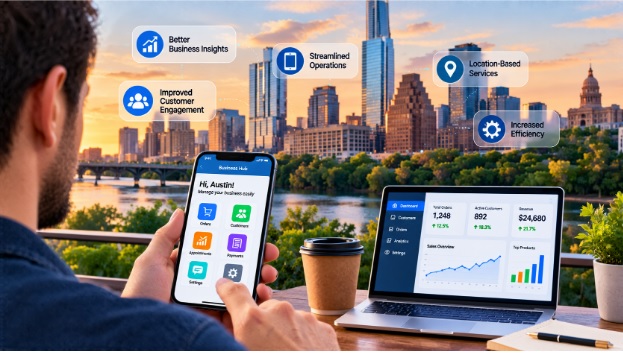
Luis Navarro owns a heating and cooling company in South Austin with eleven technicians and one very loud office phone. Not long ago, a typical July afternoon meant dispatchers juggling sticky notes while customers waited, sweating, for someone to show up. Then he moved scheduling, invoicing, and customer messages into a single app. Technicians now see their route on a phone, snap photos of the faulty compressor, and collect payment on the porch. Customers get a text with a live arrival window. The loud phone still rings, but it’s no longer the only thing holding the business together.
That shift is happening across the city, and it explains why founders from East Austin food trucks to Domain-area startups keep searching for a mobile app development company in Austin to help them build something similar. Austin has always prized scrappy ingenuity. Now that ingenuity lives in apps that save hours, cut mistakes, and make customers feel looked after. This guide explores how mobile apps are changing day-to-day operations across the city’s industries, what they cost to keep running, and where businesses stumble.
Why Austin Is a Natural Home for Mobile-First Business
Few American cities mix as many ingredients as Austin. A major university in the University of Texas at Austin, a strong startup culture around Capital Factory, big employers like Dell Technologies, Apple, Google, Amazon, and Tesla’s Gigafactory nearby, and a population that keeps growing. People move here for jobs, music, and lifestyle, and they bring high expectations for digital convenience.
The result is a customer base that expects to order, book, pay, and track everything from a phone. A diner on Rainey Street doesn’t want to wait for a paper check. A homeowner in Round Rock doesn’t want to be told “sometime between eight and five.” Austinites also compare local businesses to polished national apps from Uber, Instacart, and Starbucks, which sets a high bar for small shops.
Local brands have set the tone. Whole Foods, Bumble, Yeti, and Torchy’s Tacos all grew up here, and several lean heavily on mobile channels for sales and loyalty. Smaller businesses watch that and ask a fair question: if they can do it, why can’t we?
Field Services and Trades: Running the Day From a Phone
Texas heat makes air conditioning, plumbing, roofing, and electrical work big businesses, and field service teams are among the quickest adopters of mobile tools.
Platforms like ServiceTitan, Jobber, and Housecall Pro put scheduling, dispatch, quotes, and payments in one place. A custom app can go further by matching an exact workflow, such as a pool maintenance company’s chemical logs or a landscaper’s recurring route schedule.
For Luis, the biggest gains came from small details. Photos attached to each job ended arguments about what was broken. Digital signatures replaced lost paperwork. Technicians stopped driving back to the shop to pick up parts because the app showed truck inventory in real time. He estimates each technician now fits in one extra job per day during peak season, which adds up to serious revenue.
GPS tracking helps dispatchers reroute crews around traffic on I-35, which anyone in Austin knows can ruin a schedule in minutes. Customers get accurate arrival windows, and complaints drop.
Restaurants, Bars, and Events: Speed and Loyalty
Hospitality is the lifeblood of the city’s identity. Live music venues, food trucks, barbecue joints, and breweries compete fiercely, and apps help them stand out.
Order-ahead and mobile payments cut lines and free up staff. Reservation platforms like Resy and OpenTable keep tables full, while branded apps collect loyalty points and send offers on slow nights. Food truck owners use social feeds and location-sharing apps to tell fans where they’re parked, since the whole business moves every day.
Big events strain operations even more. During South by Southwest, Austin City Limits Music Festival, and the United States Grand Prix at Circuit of the Americas, businesses face sudden surges of customers. Apps let them manage staffing, preorder inventory, and handle mobile checkout when lines stretch down the block. A bar that can take orders at the table, or a merchandise stand that accepts tap-to-pay, captures sales that would otherwise walk away.
Retail and Local Commerce
Austin’s independent retailers, from South Congress boutiques to East Side makers, rely on strong local loyalty. Mobile apps strengthen it.
Shops use apps and mobile storefronts to offer click-and-collect, local delivery, and exclusive drops. Square and Shopify handle payments and inventory, syncing online and in-store sales. Point-of-sale systems on tablets mean staff can check stock, ring up customers anywhere on the floor, and email receipts instantly.
Customer data helps too. A bookstore that sees a shopper buys local history titles can send a note about a new Texas history release. Small gestures like that feel personal, and they keep loyal customers coming back instead of drifting to a big-box competitor.
Real Estate, Construction, and Property Management
With Austin’s building boom, real estate and construction firms move fast and juggle a lot of paperwork. Mobile apps give project managers and site supervisors tools to log inspections, upload photos, track materials, and approve change orders from the field.
Property managers use apps for tenant requests, rent payments, and maintenance tickets. A resident reports a leaking faucet with a photo, the manager assigns a vendor, and everyone sees the status. No more voicemail tag.
Agents rely on mobile platforms to show listings, schedule tours, and sign documents electronically. In a market where good properties sell quickly, a delay of an hour can cost a deal.
Healthcare, Wellness, and Fitness
Austin has a strong health and wellness scene, anchored by the Dell Medical School at the University of Texas and a large network of clinics, gyms, and studios. Patient portals, telehealth visits, and appointment reminders reduce no-shows and speed up check-in.
Boutique fitness studios depend on apps for class booking, membership management, and community challenges. Yoga studios, climbing gyms, and running clubs use them to keep members engaged between sessions.
Anything involving health data requires extra care. Providers handling patient information must follow HIPAA, and even wellness businesses should treat personal data cautiously.
Startups, SaaS, and the B2B Side
Austin’s tech scene produces plenty of software companies, and for many of them mobile is a core product feature, not an afterthought. Q2 Holdings in banking technology, SailPoint in identity security, and a steady stream of early-stage startups at places like Capital Factory all need mobile experiences that match their web platforms.
For business-to-business companies, mobile apps handle field sales, approvals, dashboards, and customer support. A sales rep can update a deal from a parking lot. A manager can approve an expense from a coffee shop. Decisions that once waited for someone to return to a desk now happen in minutes.
Remote and Hybrid Teams
Austin embraced remote and hybrid work, with many companies keeping flexible schedules after 2020. Mobile apps for communication, project tracking, and time management keep distributed teams connected. Slack, Microsoft Teams, Asana, Notion, and Zoom live on phones as much as laptops.
Employees also use apps for benefits, payroll, and scheduling. Shift workers in restaurants and retail swap shifts through scheduling apps like Homebase or When I Work instead of group texts that nobody can follow.
The benefit is flexibility, and the risk is overload. Too many notifications make people tune out. Smart teams set norms about which messages deserve immediate attention and which can wait.
What It Costs to Build and Run a Business App
Many owners focus on the launch bill and forget what happens afterward. An app is a living product, and living things need feeding.
A basic business app with a few core features, user accounts, and notifications can start around twenty-five to forty thousand dollars. A mid-range product with payments, scheduling, a backend, and an admin dashboard often falls between fifty and one hundred twenty thousand. Complex platforms with real-time tracking, multiple user roles, and heavy integrations can climb well beyond that. Austin rates sit above the national average because of local demand for talent, so some firms mix local product leadership with distributed engineering to balance quality and budget.
The part people forget is Mobile App Maintenance Cost, which commonly runs about fifteen to twenty percent of the original build each year. That covers operating system updates from Apple and Google, bug fixes, security patches, server hosting, third-party service changes, and small feature improvements. Skip it and the app slowly breaks, usually right after a major iPhone update, with reviews to match.
A few habits keep projects on track:
- Start with one problem. Luis began with scheduling and payments. Reporting dashboards came later.
- Talk to the people who’ll use it. Technicians, baristas, and front-desk staff know where the friction is.
- Launch lean. A minimum viable product tests assumptions before you spend more.
- Plan integrations early. Connect to tools like QuickBooks, Stripe, Square, or your CRM so data doesn’t get stuck.
- Think about outages. After Winter Storm Uri in 2021, Austin businesses learned the value of offline modes and backup plans.
- Measure results. Track time saved, errors reduced, and customer repeat rates, not just downloads.
Privacy, Security, and Compliance
Customer trust depends on how well a business protects information. Texas passed the Texas Data Privacy and Security Act, which took effect in 2024 and sets rules for how companies collect and handle personal data. Businesses serving customers in California or Europe may also fall under CCPA or GDPR. Payment processing should follow PCI standards, and healthcare apps need HIPAA safeguards.
Practical steps include encrypting data, limiting who can access it, writing plain-language privacy notices, and testing for vulnerabilities regularly. A breach hurts a small business far more than a large one, since reputation is everything.
Challenges Austin Businesses Run Into
App fatigue. Customers don’t want a separate app for every coffee shop. Many businesses begin with mobile-friendly web tools or wallet passes before committing to a native app.
Staff adoption. If employees see a new tool as extra work, they’ll resist. Training and visible time savings help.
Competition for talent. Skilled developers and designers are in demand. Retaining them takes planning.
Overbuilding. It’s tempting to add features nobody asked for. Discipline saves money.
Digital gaps. Some customers prefer phone calls or walk-ins. Offer alternatives, especially for older clients.
Frequently Asked Questions
How are mobile apps helping small businesses in Austin? They automate scheduling, payments, and customer communication, reduce paperwork, and give owners real-time data. Many also strengthen loyalty through rewards and personalized offers.
How much does a business app cost in Austin? A basic app might start around twenty-five thousand dollars, while complex platforms can exceed one hundred fifty thousand. Ongoing upkeep adds a yearly percentage on top.
Should I build an iPhone app, an Android app, or both? Check where your customers are. Austin skews toward iPhone in many segments, but Android has a significant share. Cross-platform frameworks like Flutter or React Native can cover both with one codebase.
How long does it take to build a business app? A simple version usually takes two to four months. A more advanced product can take six to twelve months, including testing and app store review.
Do I need an app if I already have a website? Not always. A responsive site suits many businesses. An app makes sense when you need push notifications, offline access, loyalty features, or deep integration with phone hardware.
What privacy laws apply to Texas businesses? The Texas Data Privacy and Security Act applies to many companies, alongside federal rules like HIPAA for health data and PCI standards for payments. Customers in other states or countries may bring additional requirements.
Final Thoughts
Austin has long cultivated a reputation for doing things a little differently. Mobile apps are a natural fit for that spirit, because they reward businesses that listen closely to customers and move quickly. The winners aren’t always the biggest. They’re the ones who take a stubborn everyday problem, like a missed appointment, a long line, or a lost invoice, and quietly fix it.
Luis still answers the office phone himself on slow mornings. But when a customer asks where their technician is, he doesn’t have to guess anymore. He taps the screen, reads off the arrival time, and gets back to work. That small change, repeated thousands of times across the city, is how Austin businesses are running differently now.


