


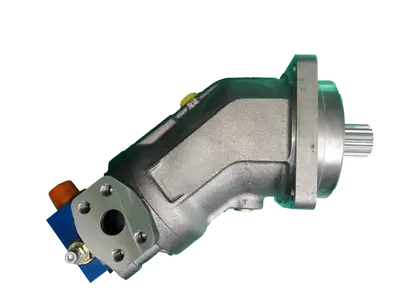
Piston pumps are widely used in industrial and mobile hydraulic systems because they can provide high pressure, controlled fluid displacement, and reliable performance under demanding conditions. Two major configurations are axial piston pumps and radial piston pumps, each with different construction principles and operating characteristics.
For buyers comparing equipment options, selecting the right piston pump manufacturer involves more than reviewing pressure and flow ratings. Understanding how axial and radial designs differ can help engineers identify the configuration that better matches the application’s performance, space, and operating requirements.
What Is an Axial Piston Pump?
An axial piston pump contains pistons arranged parallel, or nearly parallel, to the central axis of the cylinder block. The pistons move back and forth as the rotating assembly operates, creating suction and discharge cycles.
Axial designs are commonly associated with hydraulic systems that require variable flow, high pressure, compact packaging, or efficient power transmission.
How Axial Piston Pumps Work
In a typical axial piston design, the cylinder block rotates while the pistons move through their respective bores. A swash plate or related mechanism controls the piston stroke.
By changing the piston stroke, the pump’s displacement can be adjusted in variable-displacement configurations. This allows the output flow to be adapted to changing system requirements.
What Is a Radial Piston Pump?
A radial piston pump uses pistons arranged radially around a central shaft or cylinder body. The pistons move outward and inward relative to the center as the pump operates.
This configuration is particularly suited to applications where high pressure, low-speed operation, and robust mechanical performance are important.
How Radial Piston Pumps Work
As the central mechanism rotates, it causes the radial pistons to reciprocate. Each piston contributes to the overall fluid displacement through its individual pumping chamber.
Multiple pistons can operate in sequence, helping provide a consistent flow while distributing mechanical loads across the pump.
Axial vs. Radial Piston Pumps
Although both designs use positive displacement principles, their construction gives them different characteristics.
| Feature | Axial Piston Pump | Radial Piston Pump |
|---|---|---|
| Piston arrangement | Parallel to central axis | Perpendicular/radial to central axis |
| Typical strength | Compact, versatile hydraulic operation | High-pressure, robust applications |
| Variable displacement | Commonly available | Less commonly associated with variable displacement |
| Packaging | Often relatively compact | Can require a different installation envelope |
| Speed capability | Often suitable for higher speeds | Frequently suited to lower-speed operation |
| Typical applications | Mobile and industrial hydraulics | High-pressure industrial and specialized systems |
The most appropriate choice depends on the complete hydraulic or fluid-handling system rather than on one specification.
Pressure Requirements
Pressure is one of the first factors to consider when comparing piston pump configurations. Both axial and radial designs can support demanding pressure applications, but the appropriate pressure range depends on the specific pump model and construction.
Engineers should distinguish between maximum allowable pressure and continuous operating pressure. Operating continuously near the maximum rating can place additional stress on components and may affect service life.
Flow and Displacement
Axial piston pumps are often used where variable displacement and adjustable flow are required. A swash plate mechanism can change piston stroke, allowing the pump’s displacement to be controlled.
Radial piston pumps can provide precise displacement through their multiple piston chambers. Their flow characteristics depend on the number of pistons, rotational speed, displacement, and specific design.
Speed Considerations
Operating speed can influence pump efficiency, noise, heat generation, and component wear. Axial piston pumps are often selected for applications where relatively high rotational speeds are useful.
Radial piston pumps may be advantageous in systems requiring high pressure at comparatively low speeds. The manufacturer’s recommended speed range should always be checked for the specific configuration.
Efficiency and Energy Use
Efficiency is an important consideration in hydraulic and industrial systems because energy losses can increase operating costs.
Axial piston pumps can offer strong efficiency across appropriate operating ranges, particularly in variable-displacement applications. Radial designs can also provide efficient operation when correctly matched to their intended duty.
Actual efficiency depends on pressure, speed, fluid viscosity, temperature, displacement, and pump condition.
Installation and Space Requirements
Physical dimensions can influence pump selection, particularly when equipment must fit into existing machinery.
Axial piston pumps often have compact configurations that can be useful where installation space is limited. Radial piston pumps have a different geometry and may require a different mounting arrangement.
Before purchasing, compare dimensional drawings with the available installation space and connection requirements.
Fluid Compatibility
The pumped fluid and its properties must be considered regardless of the piston arrangement. Viscosity, temperature, contamination level, lubricating properties, and chemical compatibility can all affect performance.
Hydraulic systems should use fluids that meet the pump manufacturer’s specified requirements. Incorrect fluid selection can increase wear, leakage, and component deterioration.
Noise and Pulsation
Reciprocating piston movement can create pressure and flow pulsations. The level depends on pump geometry, piston count, operating speed, and system design.
Noise can also be affected by mechanical vibration, fluid conditions, mounting, piping, and drive configuration. If low noise or smooth flow is important, these characteristics should be evaluated as part of the complete system.
Maintenance Requirements
Both axial and radial piston pumps contain precision components that require appropriate maintenance. Wear can affect clearances, seals, valves, and other internal components.
Maintenance requirements depend on the pump design and operating environment. Regular inspection, correct lubrication where applicable, proper fluid cleanliness, and timely replacement of worn parts can help preserve performance.
Importance of Fluid Cleanliness
Contamination can be particularly harmful in hydraulic piston pump systems. Particles may damage precision surfaces, valves, and other close-tolerance components.
Maintaining appropriate filtration and fluid cleanliness can reduce wear and help extend component life.
Common Applications of Axial Piston Pumps
Axial piston pumps are widely used in applications where adjustable flow and high-pressure hydraulic power are required.
Examples include:
- Mobile construction equipment
- Agricultural machinery
- Industrial hydraulic systems
- Injection machinery
- Presses
- Material-handling equipment
The exact suitability depends on the pump’s pressure, displacement, speed, and control configuration.
Common Applications of Radial Piston Pumps
Radial piston pumps are often considered for applications where high pressure and durable operation are priorities.
Typical uses may include:
- High-pressure hydraulic systems
- Industrial machinery
- Hydraulic presses
- Clamping systems
- Test equipment
- Specialized power units
Their suitability should be evaluated according to the required pressure, flow, speed, and operating cycle.
How to Choose Between Axial and Radial Designs
The selection process should begin with the application’s technical requirements. Consider the following questions:
- What pressure is required during normal operation?
- What flow rate is needed?
- Is variable displacement necessary?
- What operating speed is available?
- How much installation space is available?
- What type of fluid will be used?
- What level of noise or pulsation is acceptable?
- What maintenance conditions are expected?
Answering these questions can narrow the available configurations and help engineers make a more objective comparison.
What to Ask a Pump Supplier
Before selecting a pump, request technical information that allows the proposed configuration to be evaluated under actual operating conditions.
Useful information may include performance curves, pressure and speed limits, dimensional drawings, material specifications, fluid requirements, maintenance recommendations, and testing information.
For custom or specialized systems, technical discussions should also address connections, controls, mounting arrangements, and integration requirements.
Final Considerations
Axial and radial piston pumps are both valuable positive displacement technologies, but they are designed around different mechanical arrangements and operating priorities. Axial designs are often associated with compact, variable-displacement hydraulic applications, while radial designs are frequently considered for high-pressure and robust low-speed duties.
The best choice depends on pressure, flow, speed, displacement, fluid characteristics, installation constraints, efficiency, and maintenance requirements. By comparing these factors against actual system conditions, industrial buyers can select a piston pump configuration that provides appropriate performance and dependable long-term operation.


