


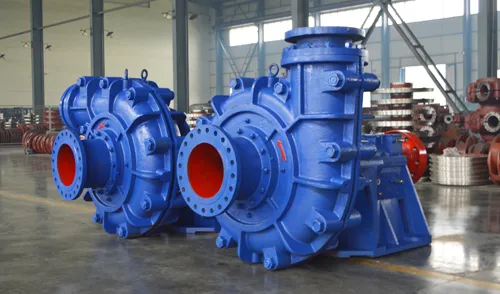
Handling abrasive materials is one of the most demanding tasks in industrial fluid transportation. Slurries can contain hard particles such as sand, ore, minerals, and rock fragments that gradually wear conventional pumping equipment.
A centrifugal slurry pump is specifically designed to manage these challenging mixtures. Its hydraulic design, material selection, and replaceable wear components help reduce the effects of abrasion while maintaining consistent slurry flow.
Why Are Abrasive Materials Difficult to Pump?
Abrasive particles can damage pump components through repeated contact with internal surfaces. As slurry moves through the impeller, casing, and discharge passages, particles can cause erosion and gradually change the shape of critical components.
The severity of wear depends on several factors, including particle hardness, concentration, size, shape, and the velocity of the slurry. Sharp and dense particles generally create more aggressive wear conditions.
How Does a Centrifugal Slurry Pump Work With Abrasive Slurry?
A centrifugal slurry pump uses a rotating impeller to transfer energy to the slurry. The impeller accelerates the mixture outward, while the pump casing directs it toward the discharge outlet.
Unlike equipment designed primarily for clean liquids, slurry pumps are built with internal clearances, hydraulic passages, and materials selected to accommodate suspended solids.
The goal is not to eliminate wear completely, but to control it and keep the pump operating reliably for as long as practical.
Key Features That Help Resist Abrasion
Several design features contribute to the ability of slurry pumps to handle abrasive materials.
Heavy-Duty Hydraulic Components
The impeller and casing are exposed directly to the moving slurry. Their geometry and construction are therefore designed to withstand repeated particle impact and friction.
In demanding applications, robust components can help maintain hydraulic performance as the pump operates over extended periods.
Wear-Resistant Materials
Materials play a major role in controlling abrasion. Depending on the application, pump components may be manufactured from hardened metals, specialized alloys, elastomers, or other wear-resistant materials.
The appropriate material depends on the characteristics of the slurry rather than simply the pump size.
Replaceable Wear Parts
Many slurry pump designs use replaceable liners and other wear components. Instead of replacing the entire pump when exposed surfaces become worn, operators can replace selected parts.
This approach can simplify maintenance and reduce equipment downtime.
The Role of Slurry Characteristics
Not all abrasive slurries cause the same amount of damage. Understanding the material being transported is essential when selecting and operating pumping equipment.
Important characteristics include:
- Particle size and distribution
- Particle hardness
- Solids concentration
- Particle shape
- Slurry density
- Chemical composition
- Temperature
- Flow velocity
For example, a slurry containing large, sharp mineral particles can produce substantially different wear patterns from a mixture containing smaller and softer particles.
How Pump Speed Affects Wear
Pump speed has a direct effect on slurry velocity and hydraulic conditions. Increasing speed can increase flow and pressure, but it may also increase the rate at which abrasive particles interact with internal surfaces.
For this reason, a pump should generally be operated within its appropriate performance range. Selecting a pump based only on maximum flow can result in inefficient or unnecessarily aggressive operating conditions.
Common Areas of Wear
Abrasive slurry does not affect every pump component equally. Wear commonly occurs in areas where slurry changes direction, accelerates, or passes through restricted passages.
The impeller vanes, casing surfaces, liners, suction passages, and discharge areas can experience significant erosion depending on the application.
Regular inspection helps identify which components are wearing fastest and whether operating conditions need adjustment.
How Proper Pump Selection Reduces Abrasion Problems
Choosing the right pump involves more than matching flow and pressure requirements. The pump must also be compatible with the physical and chemical properties of the slurry.
Key selection considerations include:
- Determine the required flow rate and head.
- Measure the solids concentration and slurry density.
- Identify particle size, hardness, and shape.
- Evaluate whether the slurry is corrosive as well as abrasive.
- Select suitable construction and wear materials.
- Consider maintenance access and replacement requirements.
Accurate operating information allows the pump to be configured for the actual conditions rather than an assumed slurry composition.
Maintenance Practices for Abrasive Applications
Regular maintenance is particularly important when pumping abrasive materials. Wear components should be inspected at appropriate intervals based on operating hours and slurry conditions.
Operators can monitor flow, pressure, vibration, bearing temperature, leakage, and power consumption. Changes in these values may indicate internal wear or another developing problem.
Replacing worn components before they significantly affect hydraulic performance can help maintain efficient operation and prevent secondary damage.
Applications Involving Abrasive Materials
Centrifugal slurry pumps are commonly used in industries where solid particles must be transported with liquid. Typical applications include mining, mineral processing, dredging, sand handling, coal preparation, tailings transport, and construction.
The exact pump configuration varies according to the material being handled and the required flow and pressure conditions.
Conclusion
Abrasive materials place significant demands on pumping equipment because suspended particles can gradually erode internal components. A centrifugal slurry pump addresses these challenges through appropriate hydraulic design, durable materials, and replaceable wear parts.
However, pump design alone cannot prevent all abrasion. Correct sizing, suitable material selection, controlled operating conditions, and regular maintenance are equally important for achieving dependable performance when handling abrasive slurry.


