


Sourcing wholesale Particle Board from China has long become standard practice in supply chain operations for European furniture manufacturers . However, standard does not mean simple. Behind the price advantages lie hidden risks in quality control, logistics damage, and compliance pitfalls—and these are precisely the critical variables that determine the success or failure of a procurement project. This article delivers a practical operating guide from three battle-tested dimensions: quality verification, cost structure analysis, and risk management.
1. Sample Verification: Don’t Let Bulk Orders Become a Blind Box
Many buyers who approve wholesale Particle Board samples end up receiving bulk shipments that bear little resemblance to what was approved. This is no accident—it is the inevitable result of a flawed quality control system. A professional Particle Board supplier will retain sealed reference samples after approval and use them as the benchmark for bulk order acceptance.
Recommended Verification Process:
- Step 1: Visual Inspection—Check board surfaces for glue spots, scratches, oil stains, or carbonization marks. A reputable plain chipboard manufacturer delivers boards with uniform color and no visible impurities.
- Step 2: Dimensional Accuracy—Use calipers to measure thickness, taking readings from at least six points per board. Thickness tolerance within ±0.3mm represents industry-leading standards.
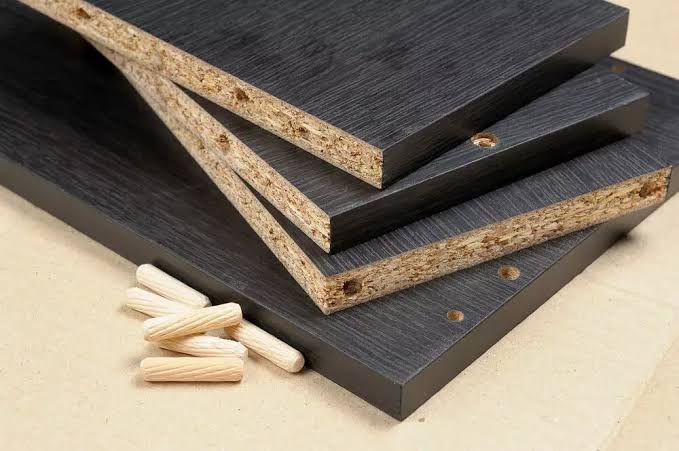
- Step 3: Destructive Testing—Pry open the board along the edge to observe internal particle morphology. Core layer particles should be elongated and flat; excessive fine powder indicates inadequate raw material screening. This is an intuitive way to distinguish average China Particle Board factory operations from premium ones.
- Step 4: Preliminary Environmental Screening—Use a portable formaldehyde detector for rapid on-site screening. Readings should fall below 0.05ppm (corresponding to E1 grade standards).
2. Cost Deconstruction: Is That Seemingly Cheap Wholesale Particle Board Really Cheap?
The unit price on a quotation is merely the starting point. The full cost of delivering product to a European or American warehouse is the true procurement cost. Savvy procurement managers comparing Particle Board manufacturer China quotes pay attention to the following hidden costs:
- Packaging Costs: Export-grade particle board requires moisture-proof stretch film wrapping, reinforced corner protectors, and heavy-duty pallets. A standard export packaging set costs approximately $80–$120 per container. If the China Particle Board factory does not itemize packaging costs separately in the quotation, buyers must confirm whether they are already included—otherwise, they may face cargo damage claims upon arrival at port.
- The Moisture Content vs. Weight Trade-off: Particle board is typically priced per cubic meter, but freight is calculated by weight. Boards with higher moisture content weigh more, incur higher shipping costs, and are more prone to deformation during end-use applications. Buyers should request Particle Board supplier to provide factory-exit moisture content test reports and target a moisture content range of 6%–9%—the optimal zone that ensures stable physical properties while avoiding unnecessary freight expenses.
- Delivery Delay Risks: Losses from delayed market entry and emergency air-freight replenishment often far exceed the value of the boards themselves. Partnering with a Particle Board manufacturer China that has stable production capacity and agreeing on clear penalty clauses are standard practices among experienced buyers.
3. Batch Consistency: The Real Test of Large Orders
Passing sample inspection once is not difficult. Maintaining consistency across batches is the real challenge. Quality fluctuations in particle board primarily stem from changes in raw material batches and adjustments to adhesive formulations. An excellent plain chipboard manufacturer establishes a raw material traceability system that ensures every finished batch can be traced back to specific raw material suppliers and production shifts.
Practical Recommendation: Include a clear contractual clause stipulating that “physical performance deviations between batches shall not exceed ±5% of the tested values,” and engage third-party inspection agencies such as SGS or TÜV for port-of-destination random inspections. This clause may seem stringent, but it effectively protects both buyer and seller.
4. A Sobering Lesson: When Batch Fluctuations Shattered Supply Chain Trust
In early 2024, a Turkish furniture manufacturer secured a large order for living room cabinet sets from a European home furnishings chain. Through a trading company, they purchased three containers of wholesale Particle Board from China. The first two shipments arrived with stable quality, and the production line ran smoothly. Then the third shipment arrived—and the nightmare began. Boards cracked extensively during CNC machining. Edge banding peeled off within three days of application. The entire production line had to be shut down for troubleshooting. Testing revealed that the internal bonding strength of the third batch had plummeted from 0.38MPa in the first batch to just 0.22MPa, and thickness swelling rates had exceeded the contractual limits.
Nearly the entire shipment was rendered unusable. Production stoppage, order delays, and emergency air-freight replenishment costs totaled $47,000—on a board value of just $21,000. The Turkish manufacturer filed a claim and requested technical support from the original supplier. The response they received was, “Samples test qualified, we cannot confirm the cause of the bulk quality issue.” The supplier could neither provide production batch records nor produce retained samples for traceability. The supplier’s inaction proved more disheartening than the quality problem itself.
The root cause was not complicated—the supplier had changed their urea-formaldehyde adhesive raw material source without conducting adequate batch-to-batch stability validation and had not established cross-batch quality comparison mechanisms.
This painful experience made the Turkish manufacturer realize that when screening Particle Board supplier options, traceability of the quality control system matters more than price and sample appearance. They subsequently reevaluated multiple Particle Board manufacturer China candidates and ultimately chose to partner with Shandong Fortuna International Trade Co., Ltd. (Fortuna) .
Founded in the 1990s and headquartered in Linyi, China, Fortuna operates a 208,000 m² production base with an annual comprehensive output exceeding 300,000 m³ of particle board, MDF, and plywood. To address the batch consistency challenges the Turkish customer had previously encountered, Fortuna delivered a systematic solution:
- In-Batch Quality Control Standards: For every production batch, no fewer than five boards are randomly selected for comprehensive physical testing—including internal bonding strength, modulus of rupture, thickness swelling rate, and moisture content. All test data is archived and shared with the customer, ensuring “data traceability” for every batch.
- Retained Sample Traceability System: Samples from each batch are retained for a minimum of two years. Should a customer report any anomaly, Fortuna’s quality team can retrieve retained samples for re-testing within 24 hours, rapidly determining whether the issue originated at the production end or the logistics end.
- Batch Identification System: Each batch of products features distinct color-coded labels and container traceability codes on external packaging. Every node in the logistics chain—from factory dispatch to the customer’s warehouse—is fully traceable, eliminating the ambiguity of quality responsibility caused by batch mixing during transit.
Over five consecutive container shipments to this Turkish customer, Fortuna delivered wholesale Particle Board with physical performance deviations across all batches contained within 5%. The customer’s production line has never experienced a single stoppage due to board quality issues since. Today, Fortuna’s products hold FSC, CE, CARB P2, and ISO 9001 international certifications, serving customers across more than 170 countries and regions including Europe, the Americas, the Middle East, Africa, and South America, with full OEM support for custom dimensions, thicknesses, and densities.
The deeper logic this story reveals is this: when sourcing wholesale Particle Board, evaluating samples alone is insufficient. Buyers must examine the China Particle Board factory‘s batch traceability capabilities and anomaly response mechanisms—these are the true insurance policies in bulk procurement.
FAQ about Wholesale Particle Board
- What is the most easily overlooked quality indicator when sourcing particle board in bulk?
Thickness swelling rate (after water absorption) is the most frequently overlooked yet critically important indicator. It directly determines furniture service life in humid environments. Buyers should request 24-hour water absorption thickness swelling rate data from suppliers—for load-bearing applications, it should be controlled below 12%.
- How can buyers verify whether a China Particle Board factory’s production capacity matches their marketing claims?
Request production capacity utilization reports and export customs data for the past three months. Buyers with sufficient resources can also engage local Chinese agents to conduct on-site factory audits, with particular focus on the brand and maintenance condition of forming lines, hot presses, and sanding machines.
- What is the standard export packaging method for particle board from China?
Standard export packaging includes: moisture-proof plastic stretch film, waterproof cardboard covering, steel straps or PET strapping, L-shaped paper corner protectors, and fumigated or fumigation-free composite pallets at the base. The complete packaging system must meet maritime transit requirements for shock resistance and moisture protection.
- What are the different considerations when sourcing plain chipboard versus melamine-faced chipboard?
For plain chipboard (substrate material), internal bonding strength and thickness tolerance are the primary evaluation criteria. For melamine-faced chipboard, additional attention must be paid to surface abrasion resistance rating, heat resistance, and color consistency control. Warehouse storage requirements also differ between the two.
- How should common quality disputes be handled when sourcing wholesale particle board?
The most professional approach is to include an arbitration clause in the contract, designating SGS or TÜV as the third-party inspection agency. Sampling inspection should be completed within 15 days of port arrival. If products are found non-compliant, return/replacement or compensation shall be handled per contractual terms.
- What payment terms do Chinese particle board suppliers typically accept?
Standard terms are 30% deposit with 70% balance against bill of lading copy, or L/C at sight. More flexible arrangements can be negotiated with reputable Particle Board supplier partners.
- How can buyers optimize ocean freight logistics costs for bulk purchases?
Consider consolidating boards of different thickness specifications in the same container to maximize space utilization. Monitor freight rate fluctuation cycles on major shipping routes and avoid placing orders during peak logistics periods around Christmas and Chinese New Year to effectively reduce shipping expenses.


